

Poor technical writing doesn’t just cause inconvenience to users, it actively kills adoption, trust, and team alignment.
Many of the most advanced AI products today are not performing well or rather I would say not adopted well. Some are built inadequately, without understanding the real-world situations in which they need to be deployed, while others fail because the products or services are not well understood. Some are developed on limited datasets, hence performance deteriorates when deployed. Also, some trained AI models are optimized for inappropriate performance metrics that do not suit overall business.
These failures rarely happen overnight, and they’re rarely just engineering problems. In most cases, they trace back to four interconnected gaps that technical content writing can directly address: (1) Miscommunication Between Technical and Business Teams (2) Why promising AI products struggle with adoption (3) How Technical Content Writing improves AI Product adoption and (4) Lack of technical content strategy.
Miscommunication Between Technical and Business Teams
The most common reason for AI project failure is misunderstandings and miscommunications about the intent and purpose of the project. Ensuring effective interactions between technologists and business experts can be the difference between success and failure. Otherwise misaligned expectations, data woes, lack of cross-functional collaboration, and failure to manage change can cause chaos. Don’t you think that poor technical writing often amplifies these problems? And do you think one key underlying reason is a lack of clarity?
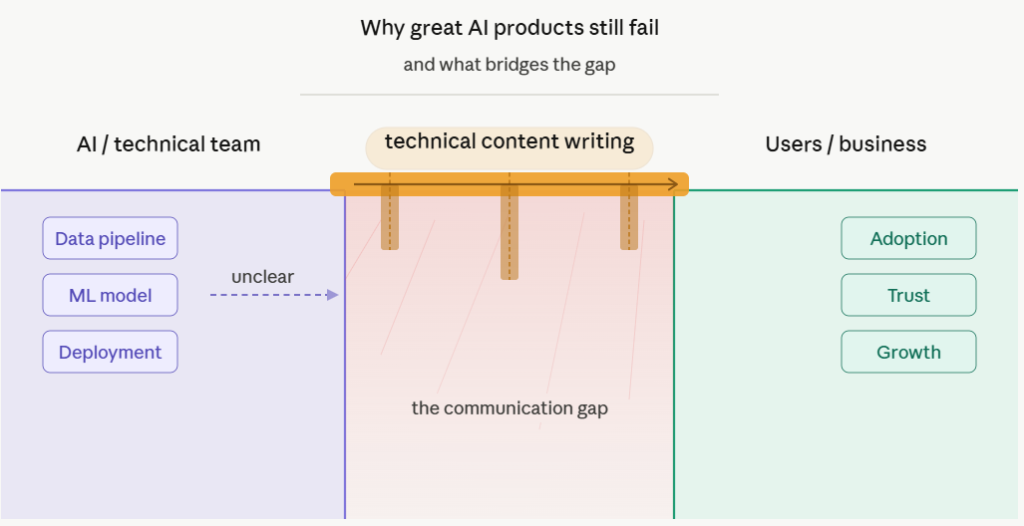
Across healthcare and supply chain, billions have been invested into intelligent systems designed to improve decisions, automate workflows, and optimize operations. Yet, a consistent pattern appears: high-potential products struggle to gain real, sustained adoption.
There are many factors behind this gap, including lack of trust, poor understanding of AI outputs, weak communication, misalignment with real-world workflows, data quality issues, usability challenges, resistance to change, and limited collaboration between technical and business teams. One key issue that I want to explore more is how much poor technical writing contributes to the failures. It is true that when people don’t clearly understand something, they don’t trust it… and when they don’t trust it, they don’t use it.
For instance, early chatbots installed in banking and many enterprise failed not due to AI limits. But because unclear prompts, poor UX copy, and lack of guidance made users drop off quickly. SAP is a prime example — a powerful enterprise system with vast capabilities, yet notorious for overwhelming, jargon-heavy documentation that widens the gap between what the system can do and what users actually understand. The result? Low internal adoption, steep learning curves, and an entire industry of external consultants built around explaining what the product itself should have communicated.
Google Glass had genuinely impressive technology, but failed to communicate a clear, relatable use case to everyday users. Without compelling content that answered the simple question “what is this actually for in my daily life?” the product created confusion rather than desire. Combined with a lack of user guidance around social etiquette and privacy, it never crossed from novelty to necessity.
People need clear to the point answers for “Why should I use this, and what problem does it solve for me? Here is where a technical content writer or a content strategist can help you with your products and services.
Why promising AI products struggle with adoption
These are not at all “bad products.” They are better described as AI products or AI-led services that attracted strong funding, publicity, or technical optimism, but did not achieve adoption or commercial scaling at the level their promise suggested. In many cases, the public record points to a mix of issues: trust, workflow fit, localization, explainability, economics, and change management. When people do not fully understand or trust a product, they do not use it consistently.
How technical content writing improves AI product adoption
Technical writing plays a critical role in improving cross-functional collaboration and facilitating proper AI adoption and change. Clear, user-focused documentation and communication help align technical and business teams, translate complex AI outputs into understandable insights, and guide organizations through adoption. By improving clarity, trust, and workflow integration, strong technical content can significantly reduce the gap between AI capability and real-world use.
Lack of technical writing strategy
Gartner mentioned in June 2025 that only 23% of supply chain organizations had a formal AI strategy. Shows that even when AI is popular, actual operational adoption is still shallow. Proper technical content writing can improve operational adoption. A product can have users, markets, and revenue, yet still fail to become sustainably trusted, profitable, or operationally sticky. Can we improve AI adoption through a proper content strategy, simplified communication, and user guides and manuals? What are your thoughts on this?
AI products don’t fail because the technology isn’t ready. They fail because the communication around them isn’t. That’s the gap technical content writing fills and it’s exactly the gap I help companies close. The most sophisticated AI model in the world is only as powerful as the clarity with which it’s explained, documented, and communicated. Technical content writing isn’t a finishing touch, but it’s a growth strategy.
I write this not just as a freelance technical writer, but as someone who has built AI diagnostic models from raw data to machine learning model building, database integration, and finally model deployment, and watched firsthand where adoption breaks down. That experience is what I bring to every word I Ready to bridge the gap between your AI product and the people who need it? To explore how I can help